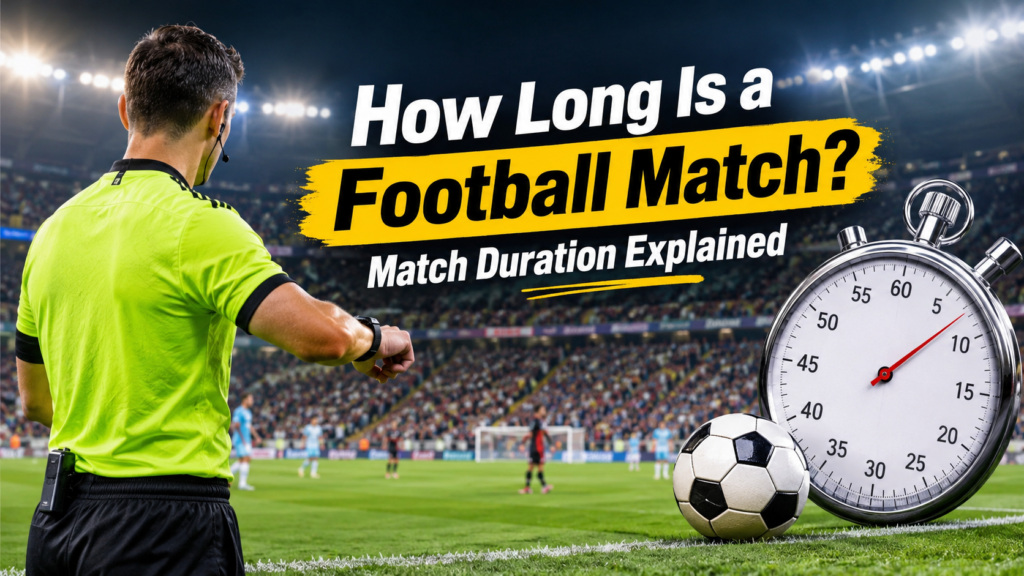
Do you remember sitting down for the big match, watching the clock tick, and asking yourself, ‘How long is a football match really?’ Technically, official regulation time is no more than 90 minutes on the pitch. But those who have ever watched the matches on Starexch know that very few matches actually end when the clock goes to the 90-minute mark. Also, live broadcasts tend to last for at least 105 minutes. Now let us find out the rules in detail.
How Long Is a Football Match? Decoding the 90-Minute Rule
The first question you’ll ask is how long is a football match and the simple math is the answer. Overall, the official rules for a match set a football match duration of 90 minutes. Yet, the split of the game is key to seeing how players save their strength.
Regulation Time Structure
A standard pitch duel has two main parts:
- First Half: 45 minutes of continuous play
- Second Half: 45 minutes of continuous play
Then how many halves are there in a football match that players fight over? Each regular contest is evenly divided into halves. Moreover, the second whistle is blown, and the continuous timer begins.
The Half-Time Pause
Between these active periods comes a mandatory rest break. But how long is halftime in football for top competitions? Official rules set the half-time break at precisely 15 minutes. During this window, managers adjust strategies, athletes drink water, and fans track live statistics on Starexch to see how the first half unfolded.
When you add two 45-minute periods to the 15-minute rest, basic math shows a standard viewing window of 105 minutes. Still, real stadium clocks almost always extend past this baseline.
The Running Clock: Why the Timer Never Stops
One way to really know how long is a football match is to observe how the time is kept on the playing field. Also, playing soccer is similar to basketball, except there is no running clock like in basketball when play stops.
If the ball is offside or lying on the field during a free kick, the main clock keeps ticking. Though the action may be stopped, the referee will continue counting the time on the main clock.
Stoppage Time: Adding Lost Minutes Back to the Pitch
Because the master clock never stops during natural breaks, officials built a smart system to restore fair playing time: stoppage time, also known as injury time.
| COMMON SOURCES OF STOPPAGE TIME | |
| Medical Assessments | Player injury checks on the pitch |
| Tactical Substitutions | Roughly 30 seconds lost per change |
| Goal Celebrations | Team momentum breaks & squad resets |
| VAR Video Checks | Offsite official review process |
| Set-Piece Setups | Positioning for free kicks and corners |
| Hydration Breaks | Mandatory heat cooling pauses |
Knowing how long is a football match means accounting for these periodic pauses:
Key Causes of Added Time
Injuries and Assessments: Medics entering the field to treat fallen players cause considerable stopping of the action.
Player Changes: Substitutions by the coach of his players take up to 30 seconds each.
Goal Celebrations: The celebration of the whole team requires additional time before the restarting of the play.
VAR Video Reviews: Modern video reviews require officials to check screen footage for critical calls.
Set-Piece Setups: Wall alignment for free kicks naturally delays action.
Intentional Delays: Squads holding a narrow lead might take extra seconds on throw-ins.
At the 45th and 90th minutes, the official holds up a board showing minimum added minutes. If the board shows “+4”, the referee guarantees at least four extra minutes. Play can go even longer if more time is lost during added time itself. Likewise, stoppage time usually adds 3 to 6+ minutes per half.
Knockout Rules: Extra Time and Penalty Shootouts
A game in the league may be a draw after playing for 90 minutes. Also, in knockout competitions, however, there is a need for an outright champion. In these high-pressure matches, asking how long is a football match leads to a much longer answer.
| Phase | Event | Duration | Details |
| Regulation Time | First Half | 45 minutes | Initial continuous playing time |
| Halftime Break | 15 minutes | Rest interval and tactical team reset | |
| Second Half | 45 minutes | Second continuous playing time | |
| Stoppage Time | Variable (3–6+ mins) | Time was added back for delays in both halves. | |
| Decisive Phase | Tied Score Check | – | The game ends if not tied; it proceeds to extra time if tied |
| Extra Time | Extra Half 1 | 15 minutes | First additional play period |
| Mid-Extra Break | 5 minutes | Quick pitch changeover and tactical rest | |
| Extra Half 2 | 15 minutes | Second additional play period | |
| Tiebreaker | Penalty Shootout | 15–20 minutes | 5 penalty kicks per team if still tied after 120+ minutes |
The Extra Time Structure
If teams remain tied after 90 regulation minutes plus stoppage time, they enter extra time:
- First Extra Period: 15 minutes of play
- Brief Interval: Quick tactical chat
- Second Extra Period: 15 minutes of play
In addition, stoppage time applies to extra periods too, adding another 30+ minutes of field action.
The Penalty Shootout
If the score remains tied after 120 minutes of play, the game moves to a penalty shootout. Five kickers from each team step up to face the goalkeeper in turn. Also, this final phase adds another 15 to 20 minutes.
Total Real-World Viewing Window
For anyone planning their viewing schedule, the actual football match length depends on broadcast coverage and tournament style. Overall, here is how standard viewing windows break down:
| Match Format | Pitch Play Time | Break Intervals | Total Broadcast Window |
| Standard League Match | 90–100 Minutes | 15 Minutes | ~ 2 Hours |
| Knockout with Extra Time | 120–130 Minutes | 20 Minutes | ~ 2.5 Hours |
| Knockout with Penalties | 135–150 Minutes | 20–25 Minutes | ~ 3 Hours |
Moreover, knowing these windows ensures you never miss a late goal or sudden shift in momentum.
Fun Fact: Why Is Regulation Set to 90 Minutes?
Ever wonder why regulation time was capped at 90 minutes rather than 100 or 60 minutes? The answer goes back to a historical compromise in 1866.
During a match in England, London clubs (who preferred shorter matches) met Sheffield clubs (who played 2-hour matches). The two groups compromised right down the middle, establishing exactly how many halves in a football match teams should play: two equal 45-minute halves. The effectiveness of this rule was so high that officials immediately included it in the official Laws of the Game, which it remains to this day.
Experience Live Action with Precision
Understanding how long is a football match lasts will enable you to keep track of every moment and even get to watch the goals scored during stoppage time. Furthermore, the thrill of running time, tactics, and extra time guarantees that fans are entertained till the very end.
Want to know more about the best sports action? Explore expert match insights, follow live team stats, and track your favourite clubs across major global leagues on Starexch today!